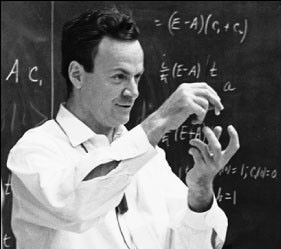
Richard Feynman
Gli Artisti del Rinascimento dicevano che l’interesse principale dell’uomo deve essere l’uomo: tuttavia ci sono altre cose interessanti al mondo e perfino gli artisti apprezzano i tramonti, le onde dell’oceano e il cammino delle stelle attraverso i cieli. Dunque ci sono delle buone ragioni per parlare qualche volta anche di altro.
Quando guardiamo le bellezze della natura, traiamo un piacere estetico dall’osservazione diretta. Tra i fenomeni della natura c’è però anche una struttura, un ritmo che non appare direttamente all’occhio, ma che si rivela solo dopo una più attenta analisi; e sono appunto questi ritmi e strutture che chiamiamo leggi fisiche.
Richard Feynman – LA LEGGE FISICA – pag. 13
Universale Scientifica Boringhieri
________________________________________
The principle of science, the definition, almost, is the following: The test of all the knowledge is experiment. Experiment is the sole judge of scientific “truth.” But what is the source of knowledge? Experiment, itself, help to produce these laws, in the sense that it gives us hints.
But also needed is immagination to create from these hints the great generalizations – to guess at the wonderful, simple, but very strange patterns beneath them all, and then to experiment to check again whether we have made the right guess.
This immagination process is so difficult that there is a division of labor in phisycs: there are theoretical physicists who immagine, deduce and guess at new laws, but do not experiment; and then there are experimental physicist, who experiment, immagine, deduce and guess.
Feynman – Leighton – Sands Lectures on Physics pag. 1.1
Addison-Wesley Publishing Company
 FISICA E FANTASIA